
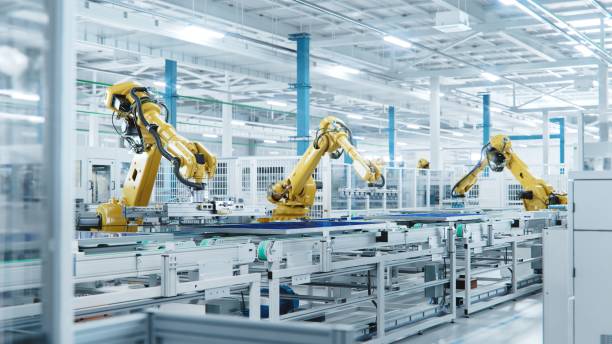

The Manufacturing Automation Landscape
Manufacturing automation encompasses a spectrum of technologies that replace or augment human labour in the production process — from the simple programmable conveyor belt that moves parts between workstations to the sophisticated collaborative robot that works alongside human operators in flexible assembly tasks to the fully automated production line that runs unattended through the night. The technologies that collectively constitute the manufacturing automation landscape have been developing for decades but are experiencing accelerating capability improvement and declining cost that is making automation economically viable for an expanding range of production tasks and facility scales.
The manufacturing automation adoption driver that has most accelerated investment decisions in recent years: the labour market pressure of reduced availability and increased cost of production labour in most developed manufacturing economies. The manufacturer that faced a choice between automation investment and continued dependence on increasingly scarce production labour has been pushed toward automation timing that market conditions alone might have delayed — and the accelerated deployment has generated the operational experience and the cost reduction that will continue to drive automation investment even as labour market conditions normalise.
Industrial Robots: Capabilities and Applications
The industrial robot types that most commonly appear in manufacturing automation: the articulated robot (the multi-jointed arm with typically six degrees of freedom that provides the flexibility to reach any point in a defined workspace from any direction — used for welding, painting, assembly, and material handling across a wide range of industries), the collaborative robot (the cobot designed to work safely alongside human operators without the safety fencing that traditional industrial robots require — used in flexible assembly tasks where the robot handles the repetitive elements while the human handles the variable elements), and the SCARA robot (the four-axis robot optimised for horizontal pick-and-place operations at high speed — used in electronics assembly, packaging, and other tasks requiring fast, precise horizontal movement).
The industrial robot economics that most determine the return on automation investment: the robot’s cycle time (how long it takes to complete one unit of work), its uptime (the percentage of available time it is actually producing), and the cost of the robot and its integration versus the cost of the labour it replaces. The robot that replaces two full-time production workers at a fully-loaded labour cost of sixty dollars per hour — representing approximately 250,000 dollars per year in labour cost — can justify a capital investment of 500,000 to 750,000 dollars at a two-to-three year payback period, assuming that the robot achieves adequate uptime and that the changeover time when switching between product variants does not significantly reduce effective throughput.
Programmable Logic Controllers and Process Automation
The programmable logic controller (PLC) — the ruggedised industrial computer that monitors and controls manufacturing equipment, processes, and machinery in real time — is the foundational automation technology that underlies most modern manufacturing equipment. The PLC reads inputs from sensors (temperature, pressure, flow rate, position, proximity), executes the programmed logic that determines what output action each input state requires, and sends signals to actuators (motors, valves, heaters, conveyors) to execute the required action. The PLC-controlled manufacturing process operates consistently, rapidly, and without the variability that human operators introduce — producing the repeatability that quality-sensitive manufacturing requires.
The SCADA (Supervisory Control and Data Acquisition) system that sits above the PLC level and provides the plant-wide visibility and control that individual PLC automation cannot: the system that collects data from hundreds of PLCs and sensors across the facility, displays the production status in real time on operator workstations, enables supervisory control of process parameters, and stores the historical data that enables performance analysis. The SCADA system that connects the production floor to the enterprise management system provides the integration that enables real-time production visibility for operations management, quality management, and supply chain coordination — the data infrastructure that distinguishes the smart factory from the automated but opaque factory.
Smart Manufacturing and Industry 4.0
The Industry 4.0 technologies that most clearly distinguish smart manufacturing from earlier automation: the industrial Internet of Things (IIoT) sensors and connectivity that enable every machine, process, and material flow to be monitored in real time and connected to analysis systems; the machine learning algorithms that analyse the sensor data to predict equipment failures before they occur (predictive maintenance), to optimise process parameters for quality and efficiency, and to identify production anomalies that indicate quality problems before defective products reach downstream processes; and the digital twin technology that creates virtual replicas of physical production systems that can be used for simulation, optimisation, and training without disrupting actual production.
The smart manufacturing ROI that most clearly demonstrates the value of IIoT and predictive maintenance investment: the reduction in unplanned downtime. The manufacturing facility where equipment fails unexpectedly experiences the cascading costs of lost production, expedited repair, potential scrap of in-process material, and overtime to recover the lost output. The predictive maintenance system that identifies the bearing that is showing early signs of failure before it seizes, that schedules the replacement during planned maintenance, and that avoids the unplanned downtime converts unpredictable failure costs into predictable maintenance costs — typically with total cost savings that justify the sensor and analytics investment within one to two years.
Evaluating and Implementing Automation Investments
The automation investment evaluation framework that most reliably determines whether an automation project is financially justified: the total cost of automation (the capital cost of the equipment, the integration engineering, the facility modifications, the training, and the ongoing maintenance and support) versus the total benefit (the labour cost reduction, the quality improvement value from reduced defects and rework, the capacity increase from higher throughput and utilisation, and the risk reduction from removing operators from hazardous processes). The automation project where the discounted present value of the benefits exceeds the total cost within an acceptable payback period is the project worth prioritising.
The automation implementation mistake that most commonly produces disappointing results from otherwise sound automation investments: the automation of poorly designed processes without first improving the process design. The automated process that executes a flawed process consistently and at high speed produces flawed results consistently and at high speed — automating the inefficiency rather than eliminating it. The lean manufacturing principle of eliminating waste before automating what remains ensures that the automation investment enhances a process that has already been improved, producing the maximum benefit from both the process improvement and the automation investment rather than locking in existing inefficiencies through automation.